
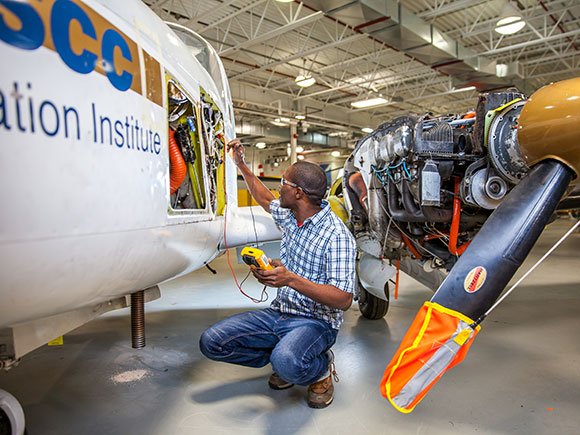
Choose an aviation maintenance school by its FAA status, practical training, total cost, and support for your goals. A good fit is more useful than an unsupported “best school” ranking.
Check the program you will actually attend
Verify the school and the specific airframe or powerplant program through current FAA resources. Ask admissions what graduation documents you receive and how the program supports preparation for the mechanic tests. FAA certification and college accreditation address different questions; investigate both when considering financial aid or transferring credits.
Compare the shop experience
Tour the labs if possible. Ask how often students work with aircraft, engines, wiring, tools, and maintenance documentation. Discuss instructor availability, class sizes, attendance policies, and how missed practical work is made up. Ask recent graduates what the daily learning experience was like.
Calculate the complete commitment
Request an itemized estimate covering tuition, tools, books, testing, housing, transportation, and likely time away from paid work. Compare published completion and placement information carefully: ask what period the figures cover and how the school defines a placement. Get scholarship and refund conditions in writing.
Compare two schools with a decision sheet
Imagine one school is close to home and another has an attractive reputation but requires a move. Compare the specific practical arrangements, not just the brand. List the ratings covered, laboratory access, schedule, travel, complete costs, support, and examination preparation side by side. Ask which claims are documented and which are only impressions from a tour. If the distant option has benefits, identify whether they matter to your intended job and whether you can realistically use them. A program that you can attend consistently, practise in meaningfully, and complete without an unmanageable interruption may be the stronger choice.
Questions that reveal student support
Ask what happens when a student struggles with electrical theory, misses a practical session, or needs more time to demonstrate a skill. Find out whether support is scheduled, available by appointment, or dependent on a particular instructor. Ask how the school communicates progress and when a student learns that they are falling behind. For career assistance, request concrete descriptions of résumé reviews, employer visits, and interview preparation. Distinguish help with a job search from a guarantee of employment. These questions help you understand how the program works when learning is difficult, which is often more informative than its best-case promotional description.
Questions to take on a school visit
Ask to see the learning spaces used by the program you would actually join. Request a description of a typical laboratory session, including how students share equipment, receive feedback, and demonstrate competence. Find out how instructors help someone who needs extra practice and how missed attendance affects progress. Bring the same questions to every provider and write down the answers immediately afterward. A well-equipped room is useful only if you receive enough meaningful access to it. Compare the practical arrangements with your commute, employment schedule, and available study time so your preferred program is also one you can realistically complete.
Build a complete education budget
Make a written cost sheet rather than comparing headline tuition alone. Include application charges, required tools, learning materials, test preparation, examinations, transport, parking, housing, and the income you may give up while attending. Mark each figure as confirmed or estimated and identify when payment is due. Ask which expenses are optional, which are included, and which might increase if completion takes longer. Keep scholarship awards separate from applications that have not yet been approved. This comparison is a planning exercise: actual prices and financial assistance depend on the provider and your circumstances. Request current figures in writing before choosing a program.
Your next steps
- Verify current FAA school status.
- Compare hands-on access and student support.
- Request total costs and exam preparation details.